Crazy
Willie Nelson's own pick to sing it turned the song down flat. Patsy Cline recorded it on crutches, nursing broken ribs, and made it the song Nelson is still remembered for writing.
 By Song Reviews · October 15, 2026
 Greatest of All Time!
Willie Nelson's own pick to sing it turned the song down flat. Patsy Cline recorded it on crutches, nursing broken ribs, and made it the song Nelson is still remembered for writing.
Willie Nelson wrote “Crazy” in under an hour in 1961 while playing bass in Ray Price’s touring band, and pitched it first to country singer Billy Walker, who turned it down because he felt the lyric was written for a woman to sing. Nelson’s own dry drawl probably wouldn’t have survived the song’s close-miked, torch-ballad intimacy anyway – the melody needs a voice that can sit right on top of the beat without rushing it, bending notes the way Nelson’s own recordings never quite do.
Patsy Cline got the song instead, and recorded it on August 21, 1961, on crutches and nursing broken ribs from a car accident that had nearly killed her two months earlier. None of that physical strain makes it onto the tape – what does is a vocal performance built entirely on restraint, holding the title word back at the start of each line like she’s still deciding whether to say it, then letting it bloom just slightly wider each time the thought returns. Producer Owen Bradley’s string-and-vibraphone arrangement, a long way from the honky-tonk instrumentation Nelson’s own version would have used, gives the recording a pop-crossover shine that helped it become Cline’s only top-10 pop hit and the record most responsible for putting the Nashville Sound on the map.
The song changed both of their careers. For Nelson, a rejection from one singer and a classic from another is as clean a lesson in trusting the song over any single interpretation as country music has ever produced.
Greatest of All Time. A ballad written for a man’s voice, turned down by the man it was offered to, immortalized note for note by the woman who sang it instead.
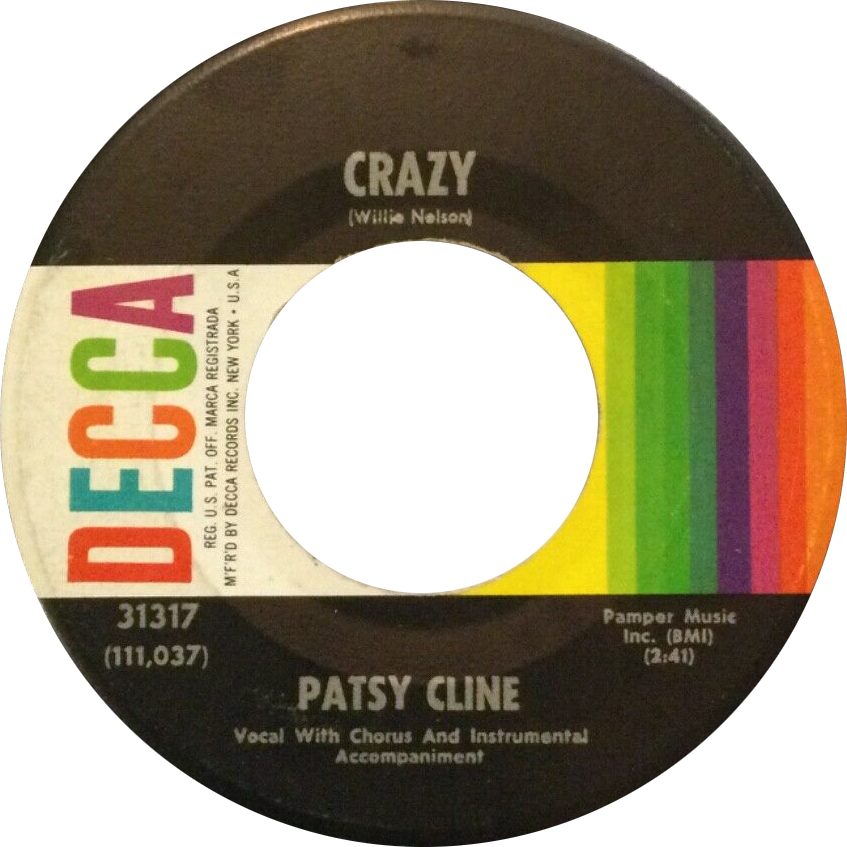
Hero image: “Crazy” U.S. single label, Decca Records, 1961. Public domain.