Fight the Power
Throwback Thursday, 1989: a production crew that stopped treating a sample as one instrument and started stacking a dozen at once until none of them were recognizable alone.
 By Song Reviews · August 27, 2026
 Greatest of All Time!
Throwback Thursday, 1989: a production crew that stopped treating a sample as one instrument and started stacking a dozen at once until none of them were recognizable alone.
By the late 1980s, sampling in hip-hop production mostly meant picking one strong element — a kick, a horn stab, a vocal phrase — and looping it. Public Enemy’s production team, the Bomb Squad, treated that approach as leaving most of the technique’s potential on the table. Producer Hank Shocklee has described the difference plainly: “Everybody would sample, but they would sample maybe a kick, a snare, or maybe just a loop of a phrase. That was the most that sampling was.” The Bomb Squad instead layered whole fragments from multiple records on top of each other until the individual sources dissolved into a single, dense wall of sound.
“Fight the Power,” written for and threaded throughout Spike Lee’s 1989 film Do the Right Thing, is the clearest demonstration of the method. Musicologist Mark Katz’s analysis found at least ten distinct samples looped together inside a single four-second passage of the track — itself repeated as a meta-loop several more times across the song — meaning what a casual listener hears as one dense groove is actually a small orchestra of unrecognizable borrowed pieces, playing simultaneously rather than in sequence. Chuck D’s own summary of the technique is characteristically blunt: “loops on top of loops on top of loops.”
The song became inseparable from the film’s climax, playing repeatedly from Radio Raheem’s boombox until it functions as the movie’s actual political statement rather than its soundtrack. It topped the Hot Rap Singles chart on release and has been named to best-song lists ever since, but the technical achievement underneath the politics is just as significant: sample-based production treated not as collage, but as orchestration, with dozens of borrowed parts playing roles no single one of them could have carried alone.
Greatest of All Time. Ten-plus samples buried inside four seconds, repeated until an entire film’s climax runs on it.
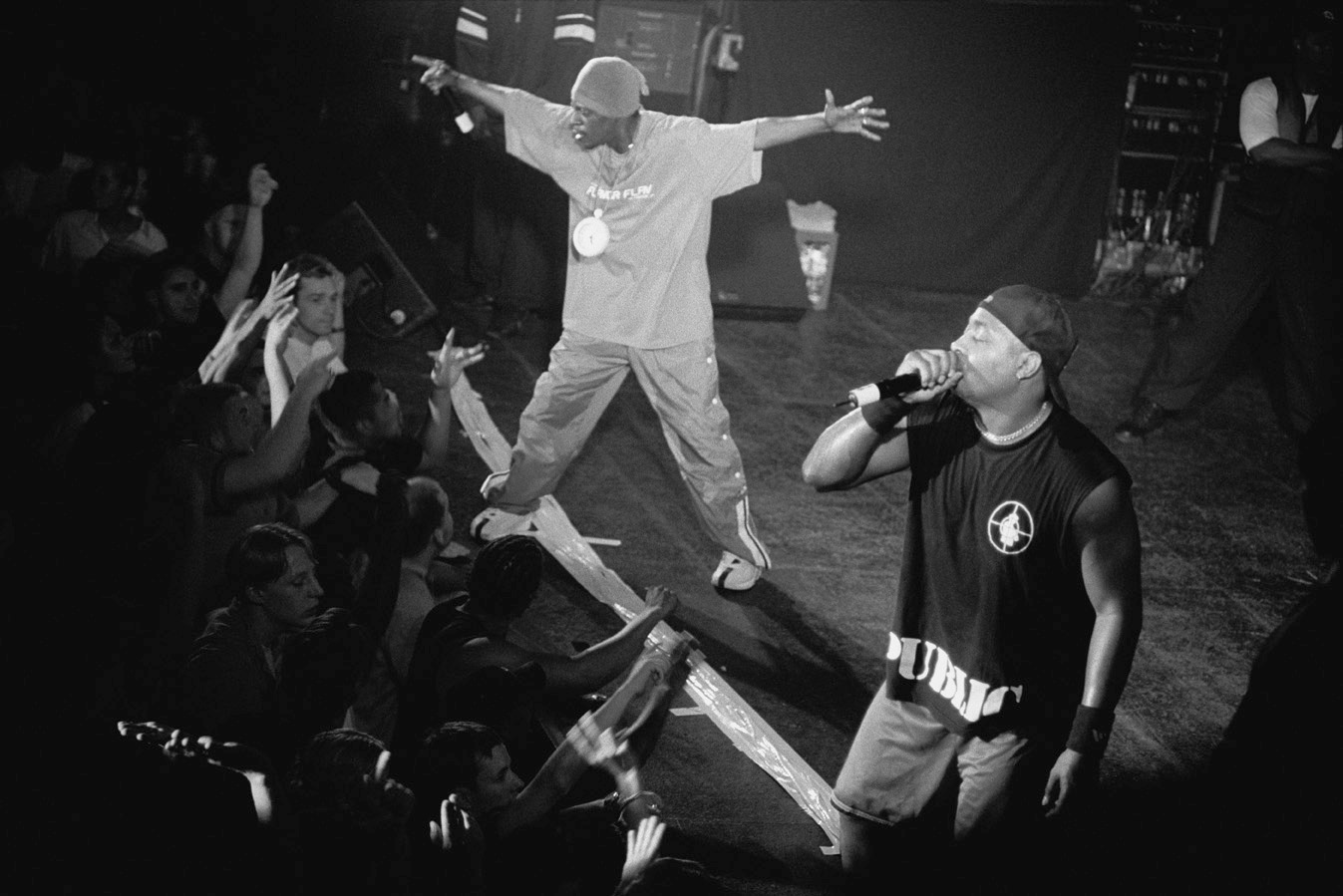
Hero image: Public Enemy performing in Hamburg, Germany, March 23, 2000, by Mika Väisänen, licensed under CC BY-SA 3.0.