How Great Thou Art
George Beverly Shea didn't write a word of 'How Great Thou Art' -- he just sang it roughly a hundred times over one sixteen-week crusade until an obscure translated hymn became a standard.
 By Song Reviews · August 30, 2026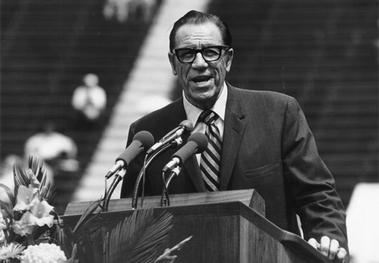
George Beverly Shea didn't write a word of 'How Great Thou Art' -- he just sang it roughly a hundred times over one sixteen-week crusade until an obscure translated hymn became a standard.
The words of “How Great Thou Art” passed through three languages and two translators before George Beverly Shea ever sang them: Carl Boberg wrote the original Swedish poem, “O Store Gud,” in 1885; a German version followed in 1907; a Russian adaptation, “Velikiy Bog,” came in 1912; and British missionary Stuart K. Hine, who encountered that Russian text while working in the Carpathian Mountains in the 1930s, produced the English translation most of the world now sings, finishing it in 1949 and adding two entirely original verses of his own along the way. None of that guaranteed the hymn would go anywhere. What actually moved it into the culture was one singer performing it, over and over, until an audience refused to let him stop.
Shea and crusade director Cliff Barrows introduced the hymn at Billy Graham’s 1954 Harringay Arena crusade in London, where it didn’t especially catch on. Shea tried again at the 1955 Toronto crusade. The real turn came in 1957, at the sixteen-week Billy Graham crusade in Madison Square Garden, where Shea sang “How Great Thou Art” so often – accounts put the number at roughly a hundred performances across the campaign – that Barrows later said they kept singing it “because the people wouldn’t let them stop.” A hymn that had spent seventy years moving quietly between languages became, over one summer in New York, the closest thing American evangelicalism had to a signature song.
Shea’s version is plain by design: a clear baritone, minimal ornamentation, a delivery built for a stadium of people who’d never heard the song before and needed it to land the first time. That’s not a limitation so much as the whole job description – Shea wasn’t recording a personal artistic statement, he was introducing a hymn to an audience at scale, night after night, and the plainness is what let a hundred repetitions still work on the hundredth night.
8.5/10 – not the most vocally ambitious reading of this hymn you’ll hear this week, but the one that’s directly responsible for the other two existing at all.
Hero image: Photo: George Beverly Shea, gospel singer at Billy Graham’s crusades. Source: Wikipedia (via “A Journey through NYC Religions”). Used under fair use – subject deceased, no free image available.