Respect
Aretha Franklin took a man's complaint and turned it into a woman's demand -- with the song's two most quoted moments, 'sock it to me' and the spelled-out title, worked out in the studio by her sister Carolyn, not written into Otis Redding's original.
 By Song Reviews · November 12, 2026
 Greatest of All Time!
Aretha Franklin took a man's complaint and turned it into a woman's demand -- with the song's two most quoted moments, 'sock it to me' and the spelled-out title, worked out in the studio by her sister Carolyn, not written into Otis Redding's original.
Otis Redding wrote and recorded “Respect” in 1965 as a man’s plea to a woman who wasn’t giving him enough of it at home. Aretha Franklin, recording her version on Valentine’s Day 1967 with Jerry Wexler and Arif Mardin producing and the Muscle Shoals Rhythm Section laying down the backing track, didn’t just cover the song – she flipped its gender and its leverage, turning a complaint into a demand issued from a position of total confidence. The writing credit still reads Redding. The song that exists in culture is entirely Franklin’s.
The record’s two most instantly recognizable moments aren’t in Redding’s original at all, and both came from the room, not the page. Franklin’s sisters Carolyn and Erma sang the backing parts, and according to engineer Tom Dowd, spelling out “R-E-S-P-E-C-T” letter by letter was Carolyn’s idea, worked out with Aretha in real time. The “sock it to me” ad-libs that follow came from the same collaboration. Franklin arranged the rhythm section’s now-iconic stop-and-start syncopation herself, meaning the record’s entire architecture – not just its vocal performance – was her design, built in the room on the day, on top of a song she didn’t write.
That’s the detail worth sitting with: “Respect” isn’t a great vocal performance layered onto someone else’s finished song. It’s a finished song’s raw material, reassembled by Franklin and her sisters into something with a different center of gravity entirely – and the reassembly is what everyone actually remembers.
Greatest of All Time. A song written as one person’s complaint became one of the defining performances of 1960s soul the moment Aretha Franklin and her sisters decided it should ask for something different.
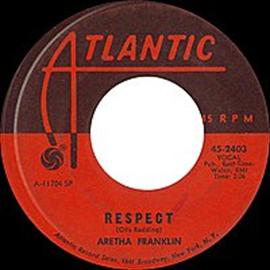
Hero image: Aretha Franklin, “Respect” single cover art, Atlantic Records, 1967. Used under fair use for editorial commentary.