You Should Be Dancing
The Bee Gees' first true disco single, 50 years old this year, is also the record John Travolta dances to alone in Saturday Night Fever -- a genre pivot that outlasted the group that made it.
 By Song Reviews · September 3, 2026
 Greatest of All Time!
The Bee Gees' first true disco single, 50 years old this year, is also the record John Travolta dances to alone in Saturday Night Fever -- a genre pivot that outlasted the group that made it.
By 1976, the Bee Gees had already lived two separate pop careers – 1960s orchestral pop balladry, then a run of soft-rock hits earlier in the decade – and “You Should Be Dancing,” off Children of the World, is the record where a third one starts. Written by all three Gibb brothers, it’s built entirely around a four-on-the-floor pulse, a horn section doing the work a guitar riff might have done a few years earlier, and Barry Gibb’s falsetto pushed further to the front than on anything the group had released before. A percussion breakdown mid-song – congas and cowbell given room to run on their own – became the record’s most sampled and imitated passage, the part that told listeners this wasn’t the same band that made “How Can You Mend a Broken Heart.”
The commercial proof came fast: the group’s first No. 1 of the back half of the decade, and the sound blueprint for the run that followed a year later, when Robert Stigwood built an entire soundtrack – and an entire film’s cultural moment – around the group’s disco pivot. “You Should Be Dancing” itself got a second life inside that film, soundtracking John Travolta’s solo dance-floor showcase in Saturday Night Fever, a scene that exists specifically because this record had already proven the sound could carry a room by itself.
Greatest of All Time! – the single that turned three former ballad singers into the most commercially dominant disco act of the era, a full year before the movie made it official.
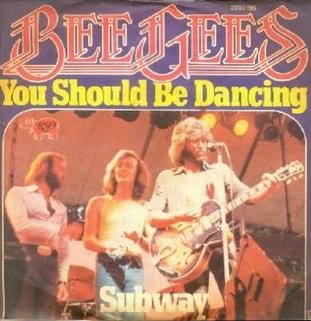
Hero image: “You Should Be Dancing” single cover, 1976, RSO Records. Used under fair use for editorial commentary.